


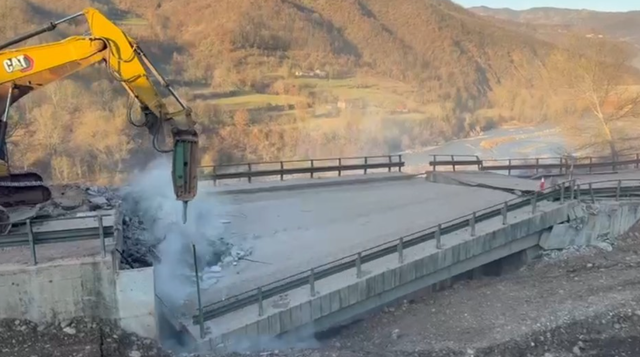
If previously a citizen departing from the Southeast terminal in Tirana towards Korça and the journey took about 3 hours, due to the deviation of the itinerary, the travel time has now been extended by up to 1 hour and 20 minutes, bringing the total to over 4 hours, depending on traffic and load on the alternative segments.
The 5-day blockade of the Librazhd-Përrenjas axis has forced intercity transport vehicles to change routes, as a result of which travel time has been extended by up to 2 hours.
The Chairman of the Intercity Transport Association, Dashnor Memaj, said that vans and buses continue to transport passengers to the cities of Korça and Pogradec, but are diverting from the route through Elbasan-Cërrik-Gramsh-Maliq.
Memaj said that currently the movements of operators towards the city of Përrenjas are blocked, but not due to the lack of use of alternative routes, but the very low flow of passengers.
At the Southeast terminal, there is no change in schedules for the departure of transport vehicles from Tirana to the Southeast cities of Korça and Pogradec, with the exception of Përrenjas where movement towards this city by means of transport does not function.
While other operators are on the move and are operating as a regular line. However, the travel time has increased significantly. If previously the Tirana - Korça route was covered in about 3 hours, currently the journey takes about 4 hours or even more. According to operators, depending on traffic and load on alternative routes to reach Korça, the journey has lasted 1 hour or 1 hour and 20 minutes.
The movement is being organized through relevant diversions, where vehicles return from alternative segments and join existing lines towards the destination of the city of Pogradec. Meanwhile, movement by van from licensed private operators towards the city of Përrenjas is currently not functioning, as there is no demand from passengers for movement.
"Even the movement by van towards the cities of Pogradec or Korça is in low numbers. The operators claim that the vehicles are moving with 3 or 4 passengers," Memaj emphasizes.
But to travel to the cities of the Southeast, the residents of these areas are using the alternative route from Dibra e Madhe, but which has resulted in higher financial costs for them if traveling by private vehicle.
Since in order to cross the border into North Macedonia, they must be equipped with vehicle insurance and if they are traveling with children (accompanied by only one parent) they must be equipped with a power of attorney for passage.
“On Saturday, when the road was completely blocked, a disaster forced me to go to Përrenjas alone with my two young sons. In addition to the hassle, I had to find an alternative route. They suggested I follow the route from Tirana to Struga to reach Përrenjas: Tirana - Klos - Bulqizë - Maqellarë - Border crossing - Dibër e Madhe (Debar) - Struga - Përrenjas.
If from the old road I just had to take the car and head towards Përrenjas, this time the situation became more complicated and my costs increased. Before leaving, I had to go to the notary to get the notarial deed for the children to pass through the customs point with Macedonia. I took out the car insurance and set off. The journey took me 3 hours,” he told Monitor NK.
Meanwhile, another alternative passes through rural areas and is significantly more difficult to navigate. Before the segment where the collapse occurred, drivers deviate from the main axis and climb a mountain road that runs from the village of Spathar towards Dardha. This segment is gravel, has sharp bends and slopes, requiring maximum caution during traffic.
After passing through the mountainous area, vehicles descend to Hotolisht and reconnect with the national road towards Përrenjas, Pogradec, and Korça.
Ticket price increases
Due to the difficulty, private vehicles are charging double the fare. Specifically, for Tirana-Përrenjas, the ticket price has increased from 500 lek to 1,000 lek.
The use of alternative routes is also increasing transportation costs for private operators, with some of them increasing ticket prices by up to 40%.
Regarding the ticket price, the Chairman of the Intercity Transport Association, Dashnor Memaj, said that there is no official report of any change, as the ticket price for the lines and rules of private operators is determined in the VKM of the Ministry of Infrastructure based on the kilometers traveled, although there may be isolated cases of abuse.
Meanwhile, according to sources on the ground, mainly passengers with emergency needs are currently traveling, due to the extended travel time and traffic difficulties.
In some cases, the price of a van ticket from 700 lek for the Tirana-Korça line has reached 800, 900 lek up to 1,000 lek, or up to 40% more expensive than the previous price.
Director of the National Civil Protection Agency Haki Çako, during today's press conference, said that the Agency has taken on its responsibilities by supporting the Albanian Road Authority for the problems created, which have brought a direct impact on road traffic and community life in the Elbasan and Korça regions.
"The National Civil Protection Agency has been in constant communication and in full readiness to deal with any emergency, including medical emergencies. All institutions involved in managing the situation have been coordinated to guarantee a rapid response and minimize the risk to citizens."
"Through a decision of the Technical Council, concrete intervention is expected to resolve the situation," said Çako.
Meanwhile, Defense Minister Pirro Vengu said that after the collapse of the bridge at "Arrat e Gurrës", the process has been made public and the construction of a new axis is in the decision-making phase, with a focus on the safety and lives of residents, as well as facilitating access in case of emergencies.
This article was published by Monitor.al and reposted by Tiranapost.al


