


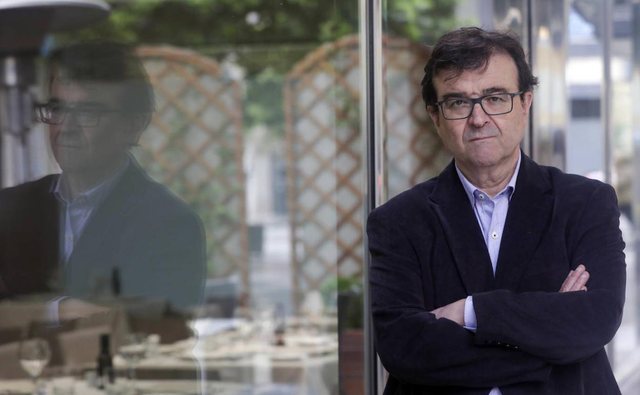
By Javier Cercas/ In the spring of 2015, I spent almost two months running the Weidenfeld Lectures, an annual series of conferences founded by George Steiner at the St. Anne's College”. It was just a form of carelessness on my part. Italo Calvino died shortly before delivering the Norton Lectures, a similar series of lectures held at Harvard, and his wife, Chichita, confirmed that he died of panic at having to speak in front of such an erudite audience. What saved me was courage, or simply shamelessness.
Calvino, who was a scholar of the highest class, had perhaps forgotten that true scholars are infinitely generous: this is proved by the fact that, despite the eminences who preceded me in the "Weidenfeld Lectures", not only did I not get hit with tomatoes during my speeches, but they ended up making me an honorary member. One thing is clear: the prestige of Oxford can withstand anything.
I mean those were happy days for me. I learned a lot, because it's impossible to spend time at Oxford without learning a lot. The first was that José Ortega Y Gasset, who never went to Oxford, was right when he warned us against the “barbarism of specialism”: wisdom is not achieved by closing in on one's own specialty, but by opening up to others, however they seem distant. I experienced this often-forgotten fact myself: my lectures, which were about literature, would start just as I finished speaking and the questions would begin, allowing all kinds of people to chime in, from historians and philosophers to sinologists and scientists.
Thus I realized the second thing that can be learned at Oxford, where anti-specialization is the norm (indeed, this is one of the basic reasons for the existence of the college, where professors of different specialties lived together and where, to this day, they eat breakfast, lunch and dinner with experts in various fields): if the participants in a conference are good, the speaker learns more from them than the participants learn from the speaker himself.
The third thing I learned is that loving wisdom is just as reasonable as not sanctifying scholars. One evening I took part in a public debate on Europe with one of the most respected political analysts in Great Britain and perhaps the world. The referendum on Brexit had already been decided and it was impossible not to talk about it. Later, during dinner, I asked my interlocutor if he thought that the result of the referendum could come out the way it did: "Let's say it between us", he replied, "no chance!".
The fourth thing I learned is even more important. In St. Anne's lived next door to an old Indian woman. I always saw her walking around the campus with her head down, her gray hair and colorful saree. Sometimes, he attended my lectures. We became friends. It was, and still is, called Devaki Jain. She is an economist and was a pioneer of feminism in India. He had studied at St. Anne's and had returned to her university to write the memoir. She was obsessed with doing this, but she had not written a single line and since I was dealing with literature, she asked me for advice.
"Tell everyone how much you lived, as you lived it, without adding anything else," I told him. But the memories were still not coming out. Until one evening he told me the secret he kept inside. "Do you know Javier", he told me, "I have done so many things in life that I don't know how to tell them without appearing arrogant". This is the fourth thing I learned. Humility is the trait of the best.
The fifth is that every moment of the day can be made the most of in Oxford. I realized this again when I returned. In almost 24 hours I managed to do a lot of important things - from dinner with friends to jogging through the deserted streets of downtown at dawn - including the most important of all, doing nothing.
Until the 19th century, the word "homeland" did not have the frightening meaning it has today. For Cervantes, for example, the homeland is that small, intimate and welcoming place where our friends and memories are and where we would always like to return. And that's the last thing I've learned in Oxford, so far: that this city knows how to be home.
*Javier Cercas is among the most widely read contemporary Spanish writers, also a professor of literature at the University of Girona. Author of more than 12 novels, several of his books have been translated into Albanian, such as "The Deceiver", "Monarku i hijeve" and "Soldiers of Salamis". The article was translated into Albanian by Erjon Uka.


