

The story of the Albanian couple in Italy: Doctors and parents in the difficult time of coronavirus

2020-06-28 09:45:28
TiranaPost
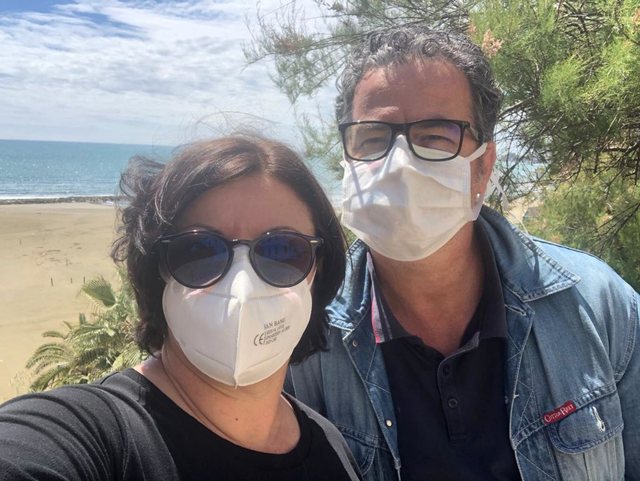
Zhuljeta Ceni is an Albanian doctor in Italy, who together with her husband Altin Kola have been on the front line of the fight against coronavirus COVID-19 and their work starts at 5 o'clock in the morning: We have to hurry to work, we kiss the children and put on the mask, Zhuljeta says in an interview for ATSH.
The couple has emigrated to Italy for 20 years after completing their studies at the Faculty of Medicine at the University of Tirana. They live in Nettuno, a city in the province of Rome with their two children Martina, 15, and Andrea, 10.
Altini works as a doctor at ICOT Hospital in Latina, a hyperbaric center, and Zhuljeta as a laboratory doctor at S. Maria di Loreto Nuovo Hospital in Naples.
They confess that in the hospitals where they work, they were directly confronted with the situation created by the coronavirus pandemic.
"When we graduated from the University in 1998, we started a new challenge, immigration, with clear ideas to create a future different from what we had lived until 1998. So at the end of 1999 we came to Italy, where in a short time, with the will, and the desire that characterized every Albanian at that time we managed to practice our profession as a doctor ", says Zhuljeta.
"With the enthusiasm of a young doctor and the opportunities that were offered, we entered a pace of life with extraordinary speed. For many people being a doctor is a privilege and we have tried for a long time to convince ourselves that it is a privilege and adding back that it is a duty, passion, dedication, risk, stress, but it is also endless pleasure to understand and act for save lives, ”she continued.
Zhuljeta was the person in charge of analyzing patients hospitalized with COVID-19. She says the first few days were quite difficult as little was known about the COVID-19 virus and the extent of the spread was not yet known. But she confesses that as the days went by, in addition to the unknown, the number of patients with coronavirus hospitalized in the hospital where she worked increased.
"COVID-19 took away the pleasure of being a doctor from the first deaths, took away self-confidence, took away security, increased stress, risk, added the powerlessness to defeat the virus, when everyone saw doctors as heroes, we saw ourselves as incapable of fighting an unknown enemy, but determined to be on the front lines of the war ", says Zhuljeta.
"The beginning of March was the most difficult period for us. With the closure of schools for parents working as doctors, the stress did not come from fear of the virus, but how we would manage to be a parent and a doctor at the same time, away from relatives' families, how to organize night tours to don't just leave the children, "she said.
"How could we protect them from the danger that we were exposed to every day, since the hospital where I worked in March turned only COVID. 24 hours a day was not enough, math and grammar teachers in the morning, mom and dad at lunch, friends playing in the afternoon and at night at work. If we all got together one whole day a week it was a luxury. Maybe the fast and relentless pace that we were forced to apply did not leave us time to think and reflect on the situation we were living in.
On the other hand, in the hospital where Dr. Altini works as a hyperbaric doctor, even though it was not a COVID hospital, the work continued the same as before, taking all safety measures against COVID so as not to interrupt the therapeutic continuity of patients in treatment. functioning center throughout the prefecture of Lazio. He says it was difficult at first to deal with the disease, which was unknown and there are still some aspects that are not yet fully understood.
He emphasizes that all the protective measures were taken in the hospital where he works. "Patients came to the hospital looking for care," he said.
Currently, the situation seems calmer, but everyone is afraid of a comeback or a second wave, which would certainly bring difficulties to the health system.
Asked how he assesses the situation that our country went through in this pandemic, Dr. Altini said that Albania managed to withstand the first wave of pandemics very well, having a small number of affected.
"Albania's difference with Italy is because the population in Albania is different, the settlements are different. In fact, the spread in Albania was greater where there were people coming from abroad, especially with Italy and where the population density is high, for example Durrës, Tirana, Shkodra, Kruja, while the eastern part of Albania where the population density is low. there is less virus spread, ”he says.
Their appeal is for the citizens to be aware that the virus has not yet left and that the doctors' advice should be followed and that care should be taken with personal hygiene.


