


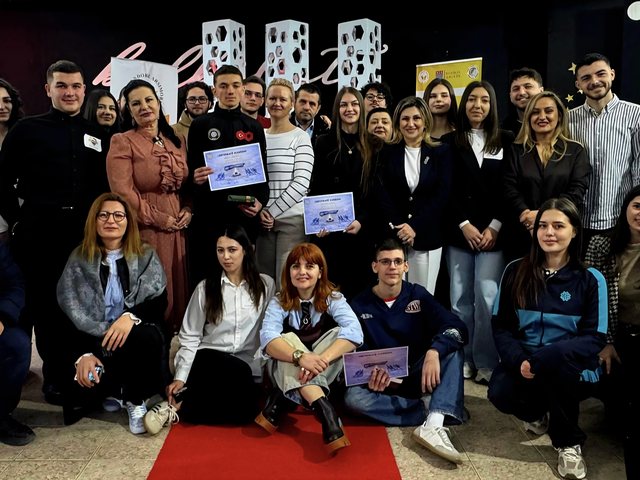
At a time when the most common complaint of adults about teenagers is “they don’t put their phones down”, a room full of high school students in Shkodra this Wednesday gave me a completely different answer. For 90 minutes of live debate, not a single cell phone was on. No screen illuminating their faces. Only eyes searching for the word, hands pressing the button and arguments “colliding” with each other. “60' ARGUMENT – Run to the Argument” is an initiative of the Psycho-Social Service at the Shkodra Local Education Office, which brought together 18 high school students from 9 schools in the city in a dynamic format with three rounds of debate. February is now also known for Safer Internet Day, and this competition was organized with this motive. Previously unknown topics, 60 seconds to think, pressure, counterargument, communication ethics. A small laboratory of democracy in real time. I had the special pleasure of moderating this meeting: sociology, argumentation, technology, young people, especially in Shkodra. So to speak, every argument that my professional work focuses on, gathered in a single experience. I was invited to be the moderator, but of course, observation, this very strong weapon of mine, I did not leave without using it this time either. The jury, of course, based on the evaluation criteria, followed each debate and tried to evaluate the best for the strongest argumentation. But in my view, the strong meaning of this debate lies elsewhere:
1. Silence of the phones. I have tried to control the room with my eyes the whole time. Excuse me, dear teachers… you also sometimes opened your cell phone, maybe to take pictures of the students, maybe to coordinate your private affairs… but the students, even those who followed their friends' competition, not just those who were competing, I almost never saw them open their phones. I have to stop here for a moment. If for 90 minutes young people choose not to touch their cell phones, not because someone forbade them, but because they are involved, challenged, listened to, this is a strong bell that rings for us. While we declare them sworn “enemies”, could it be that social networks are, in fact, just a substitute for what they lack: attention, real challenge, belonging? Often, in my experience, I happen to understand firsthand that, when we offer young people and children spaces where their words have weight, where their opinions are taken seriously, they themselves choose to take their eyes off the screen. Perhaps our question should not be why they stay on social networks. I think the real question is: what are we offering them beyond them? The developed world is talking today about a fatigue of users from social networks, a trend towards “zero posts”, a decrease in interest in certain formats and platforms and, in parallel, increasing restrictions on their use. What is the next step? What will attract the attention of our children?
2. This meeting was filmed to be broadcast on one of the main local media in the city. I think that more than young people or their families, the program should be watched by journalists themselves, show hosts and a "bunch" of people who live in our country talking in studios. 18 young people from Shkodra will teach you how to speak, defend or refute an argument, without shouting, without interrupting anyone, without insulting.
In my view, the third strong point of this organization was at the end. An open question, without alternatives, without imposed direction: how do they see the Psycho-Social Service in schools? The answers were clear, warm, direct. Since here they did not have to argue as lawyers for or against a certain issue, the young people spoke differently. They were even more truthful, more convinced in what they said, clearer, which is why perhaps they escaped a few words in English. In this answer, they also used humor and showed something of themselves. They spoke about support, about quality time, about real help, about the decline of the stigma of meeting a psychologist, about the feeling that someone listens to them without judging them. In a society like ours, where the psychologist is still often seen as a “solution to the problem,” these young people describe the psychosocial service in schools as a space of safety, as normality, as a need.
I would invite everyone to read this as a strong signal. This is not about applauding the success of a service; this will take time and professional mechanisms to prove. This reaction of the Shkodra high school students, in my opinion, is an indicator of the need for attention, for sincere communication, for real relationships with adults. Once again, it seems to me that our children are demanding more presence from us. At the end of those 90 minutes, the winners received the applause. But perhaps the greatest gain was elsewhere: in the fact that, when offered real space, young people choose dialogue in front of the screen and communication over isolation.
The question I have at the end for today is quite simple: will we seize this moment?


