


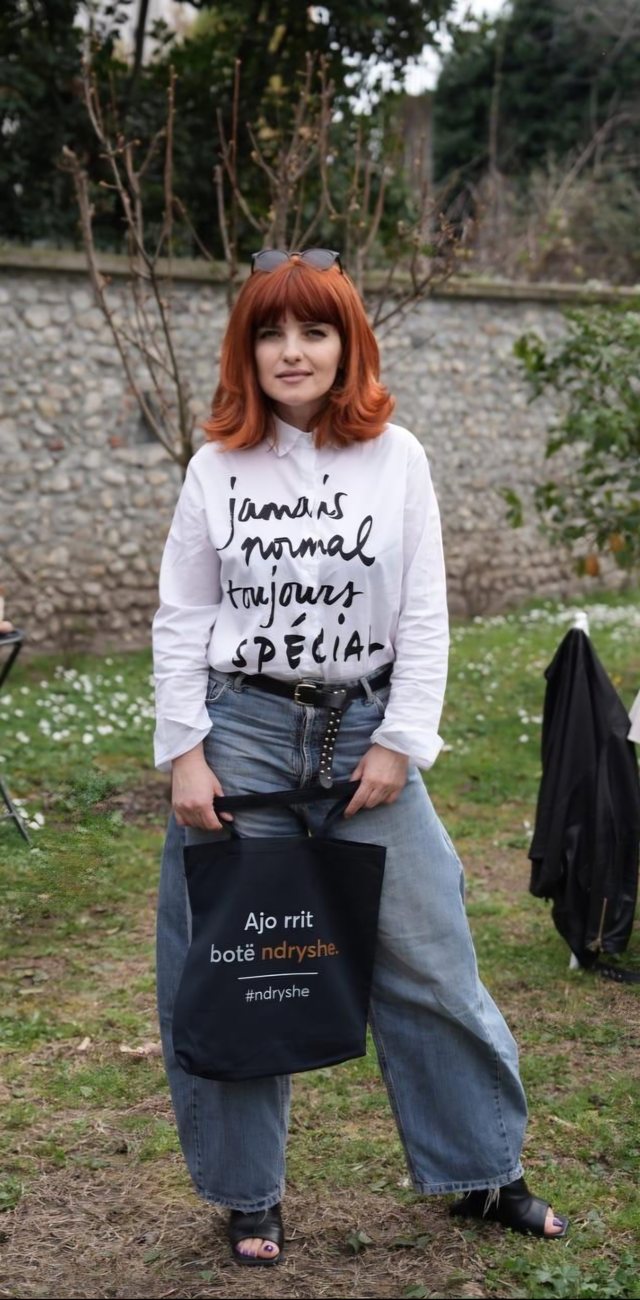
There are some topics that I avoid and avoid, because firstly I don't want to hurt anyone, and secondly, because I have chosen a long time ago to put a positive filter on our society and its behaviors. That is, to see something positive and from there to give my opinion. Or as in today's case, to intertwine it with the opinions of different researchers, all over the world. So for today's topic, I was inspired by not one, but two beautiful events.
The first one happened in Shkodra 😊. I received an invitation to attend a meeting with a title that honors the days we live in. “Women who shine”, it seemed like a meeting to celebrate women and their efforts. Of course, I accepted the invitation with great pleasure. I must say that that meeting in the courtyard of a Shkodra house turned out to be much more than a gathering of girls and women. With the ease that creates an environment where everything looks beautiful, the food is good, the conversation is warm and there is even no shortage of gifts, there was a discussion about a topic that we do not actually touch on easily, much less try to solve easily. So more than 30 women and girls understood that they had invited us to ask for our support to help an issue that we still talk about in silence. How can we come together to launch a series of activities that can make the lives and efforts of mothers and families with children who have disabilities and need specialized help easier? There was no shortage of ideas, nor was there any lack of involvement from each participant to provide her concrete, well-thought-out, useful contribution. I promise that in the future I will introduce you to every initiative that we can strengthen together,
This week I followed with curiosity and appreciation Jonida Maliqi's story (thank you Zefina for encouraging me to listen to it with your writing). Her words about her relationship with her son, her challenges and achievements, and above all, her love, spoken so simply and truthfully, are perhaps the strongest message this artist has ever delivered in her many years of public life.
So I thought these strong positive encouragements could be a nice and very concrete start to my writing this week.
Every parent has a period in their life when they start to worry about something they notice in their child. Even more so when they start comparing them to other people's children. They don't talk fast, they talk a lot, they are very energetic, they are very withdrawn, they are bothered by food, they want to eat everything, they cry in their sleep, they get scared easily, they are very sensitive... Fear affects us all, even doubts, even the urge to read online. Often because of this fear we deny it, we often ask ourselves why this is happening to us, where did we go wrong... but perhaps the best question is actually another one:
What is my child trying to tell me?
Here we cannot always find the answer ourselves, we need the help of someone who understands, reads, studies, observes. But in addition to the therapies that must be done whenever necessary, without ever compromising the role of doctors and specialists in the field, today I wanted to share with you the position that reflects a series of studies and observations from the best international experience. In the contemporary literature of developmental psychology, researchers such as Thomas Armstrong, Temple Grandin and Barry Prizant talk about the concept of neurodiversity, emphasizing that many of the differences in the way children think, feel and learn are part of human diversity and not necessarily a problem that needs to be corrected.
Often, children who seem different to us do not need to be corrected, but need to be understood, to be adapted to our language. The intensity with which they understand this world that changes daily is different from ours. There are many cases where the problem is not with the child, but with our expectations of him. We have built a format of “normality” in our heads and expect the child to follow it stage by stage. But the development of the child is neither the same for everyone nor uniform. Behind our concern for change, there should not be fear or hurt that our child is not good enough. We should not necessarily run to correct him. First, we should carefully observe, ask, try our best to understand. A child with a lot of energy may be moving too little, perhaps he is eating inappropriately for his age, perhaps he simply needs to run. A child with a lack of concentration may be better taught with a different method, and for those with a lot of sensitivity, perhaps we should learn to value the emotional intelligence that they have developed more than us. Often the best thing we can do as parents is to be willing to learn together with our children. To accept as a start that the greatest help we can give our children is to see them as individuals, not as a problem that needs to be solved. This means seeking advice from specialists when necessary, being open to new methods of education, but above all creating an environment where the child feels safe to be themselves. We need to start with ourselves, even though this may seem the most difficult thing. Many of the children who seem difficult today will be the ones tomorrow who will think differently, create differently and change the world. And perhaps the simplest truth is this: Let's help them grow up in a different world, they don't need us to make them like everyone else. They need someone to help them become the best version of themselves.


