

In 2027, "artificial superintelligence" will surpass human beings (and we will risk extinction)

2025-04-20 11:25:34
TiranaPost
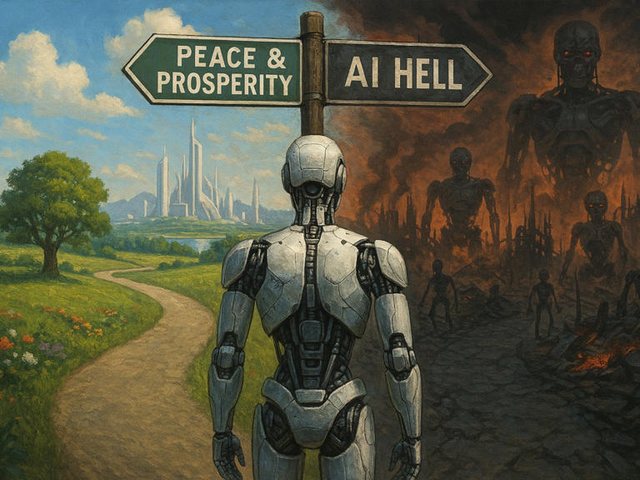
Is humanity near a historical turning point?
According to a recently published study, in October 2027 we will reach a crucial moment that could determine the future of humanity. On the one hand, there is the opportunity to slow down the development of artificial intelligence, to avoid the risk that these technologies will one day get out of control and turn against us. On the other hand, there is the pressure to move forward without brakes, to not fall behind in the global technological race — especially in the face of the great advances taking place in China.
These two paths constitute completely opposite scenarios. One could lead to the complete destruction of humanity, while the other promises a utopian future — an intergalactic civilization built on peace, harmony, and advanced coexistence between technology and humans. According to the authors of this study, this epochal change is not far off: it will occur just one year and three months from the time the report was written, when an AI will be created that will be more intelligent than any human on Earth.
Is this a dystopian novel? Alarming science fiction?
Actually, no. This is a prediction based on detailed data and analysis, part of the study titled “AI 2027”, carried out by a group of researchers in the field of artificial intelligence. One of the most prominent names among them is Daniel Kokotajlo, a former employee of OpenAI, who in 2024 left the company, stating that he had lost faith in it to act responsibly with the power it was creating.
In this study, the development of AI is described through a story built around a fictional company called “OpenBrain,” whose name is a play on words reminiscent of “OpenAI.” This company creates artificial intelligence models that are not used for commercial or economic gain, but only for scientific research and development. Each new, more powerful model is used to help build and train the next model — a process that causes an exponential increase in the capacity of these systems.
According to the study's scenario, in less than three years we could have a model called "Agent-4" — an AI so advanced that, even operating at the speed of a human brain, it would be qualitatively better than any researcher in the world in the field of AI. But the impact of this technology will not stop only in science. These models are expected to affect all strategic areas: from programming and hacking, to the construction of biological weapons, and even political decision-making.
The year 2027 is described as the moment of the true explosion of artificial intelligence.
In March, an AI will appear that codes better than any programmer in the world.
In August, a model that can conduct scientific research better than any researcher.
In November, a “superintelligent” AI in the search for AI itself.
And in December 2027, according to predictions, the so-called “artificial superintelligence” will be born — a system that will surpass humans in every mental ability: analysis, decision-making, creativity, and problem-solving.
This study is not a call to panic, but a warning to reflect. If these developments really happen, they will forever change the way we live, work, think, and coexist. The big question remains: Are we prepared for a world where artificial intelligence surpasses us? And if not — what can we do now so that it is not too late?


