


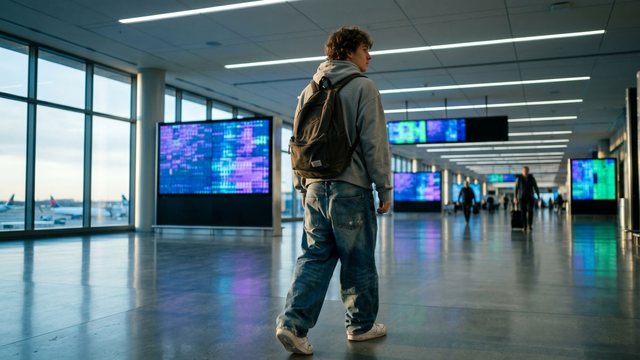
I was rushing through the airport one day when I saw a guy, maybe 19 or 20, wearing the exact same baggy jeans I had in 1993. I had bought mine at a run-down strip mall in suburban Northern California because I thought they made me look like someone who understood skateboarding. When I saw them on this guy, more than 30 years later, I braced myself for that “oh my God, I’m getting old” feeling that comes with seeing your youth appear in someone else’s wardrobe.
But that didn't happen. What I felt was more like recognition, but I couldn't quite figure out what I was recognizing. I don't want to give those pants back, and I don't particularly miss 1994, which I remember mostly as a time of deep uncertainty. The feeling was of something below the pants, of a quality of experience that I suddenly felt I was missing, like when you walk into a room and you know something has shifted, but you can't quite put your finger on what.
Anemoia
I've been spinning this feeling around in my head for weeks, partly because I see it everywhere. The internet has decided that 2026 is the "new 2016." There's even a whole Wikipedia page about the phenomenon.
Then there's the beautiful word anemoia, coined by writer John Koenig, which describes nostalgia for a time you never lived through.
Millions of young people have embraced the term recently, because it gives a name to a pain they've felt but haven't been able to express. They're buying video cameras, creating social clubs without phones, building entire identities over decades that ended before they were born.
The common explanation, that nostalgia is “emotional nourishment” we seek when the present gets tough, is true to a certain extent and supported by research. But it doesn’t explain what I felt at the airport. That feeling wasn’t warm and fuzzy like nostalgia is supposed to be. It was sharp, like a signal that draws your attention to something you hadn’t noticed was missing.
Now I think I understand what's happening.
When you hold the pen
When researchers analyze the content of nostalgic memories, a clear pattern emerges that most people don't notice: the self is almost always the protagonist. These aren't just memories of comfort or warmth. They're mostly memories of acting on your own volition—planning a trip with a paper map, calling a friend on a landline and talking for hours about mundane things, walking into a record store without knowing what you were looking for and walking out 45 minutes later with something you had chosen yourself. The scenes that the mind remembers are the ones where you held the pen.
Another important finding deepens this idea.
Studies at the intersection of nostalgia research and self-determination theory suggest that when a sense of autonomy is limited, when people feel like they have no choice, nostalgia is activated almost automatically, like an internal alarm. The mind senses a lack of agency and reaches back into the archives to find evidence that you were once a self-determiner.
And that touched me. Because if nostalgia is triggered, when the mind feels like you've lost the ability to choose, then I have to wonder why this alarm is going off so often today.
The cured self
Most of us think of nostalgia as a feeling for the past. And in a way it is. But it is just as much about the present: it is a signal that you have lost more authorship over your experience than you think. And the reason this signal is being triggered so often has to do not only with the passage of time, but with the way many of our daily experiences are already “written” for us without us even noticing.
I remember that guy at the airport. I realize now that the feeling had nothing to do with 1993 or those pants. It was my mind telling me, in its own silent way, that somewhere along the way I had let go of my pen more often than necessary. And a guy in baggy jeans just happened to walk by just as I was about to hear it.


